Regulärer Preis
€18,95 EUR
Verkaufspreis
€18,95 EUR
Regulärer Preis


There are places in Peru that exist at the edge of what maps consider worth recording. The upper Urubamba basin is one of them — a region where the Andes lose their confidence and descend, reluctantly, into something older and less legible. The jungle begins here not with drama but with accumulation: more trees, more moisture, more silence between human sounds. Roads become suggestions. The air, at a certain altitude, changes its character entirely.
Koribeni is in this part of the world.
It is a Machiguenga community — one of the Arawak-speaking peoples who have occupied these valleys since before anyone thought to write such things down. They are not, by temperament or history, a people who sought contact with the outside. For most of the twentieth century, the outside largely returned the favour. Catholic missionaries came, found the terrain difficult and the locals unmoved, and largely departed. What remained was something rare in this century: a place that had not been fully processed by modernity. The cacao trees here grow the way they have always grown — in the old polyculture, alongside native flora and animals and insects, the entire system ticking along with an indifference to markets that the markets have never quite forgiven.
The cacao is called Chuncho. It is one of Peru's most ancient cultivated varieties, shaped by altitude and microclimate and genetics that have never been fully mapped. It does not grow evenly or predictably. It does not lend itself to industrial harvesting. It is, by every commercial measure, inconvenient.
It is also extraordinary.
A Norwegian woman named Vigdis Rosenkilde came to understand this after selling her Oslo apartment in 2015 and disappearing into Latin America for reasons that must have seemed, to people who knew her then, somewhere between impulsive and inexplicable. She had read an article about cacao — the revelation that chocolate, like wine, held different flavours depending on origin, that the same bean grown in different soil produced something fundamentally different. The idea, as she describes it, would not leave. She had been working as a confectioner in Oslo. She decided to liquidate and go.
Brazil first. Then Peru, Honduras, Ecuador, Nicaragua. More than fifty cacao plantations across a year and a half, tasting and learning and arriving unannounced at farms that had never received a Norwegian visitor and likely never expected one. In Peru she found what she had been looking for — the best cacao, the best partners, the strongest sense of connection to the thing itself.
It was in a Peruvian jungle that a professor named Wilton, who kept an experimental farm with over a hundred different cacao trees, cracked open a fruit and handed it to her without explanation. She brought it close. The scent that came from it was roses. Not a suggestion of roses. Roses, unmistakably, rising from a cacao pod in the middle of the Amazon basin. Her surname, Rosenkilde, translates from Norwegian as source of the rose. She had spent years obsessing over cacao's floral potential without ever thinking to look for this particular flower. She understood in that moment, she has said since, what she had actually come to find.
The variety was Chuncho. The place, eventually, was Koribeni.
Vigdis spends roughly three months each year in Peru now. She is present at fermentation, at drying, at every stage that touches flavour. She buys directly from farmers, tastes every batch herself, and makes the chocolate in Peru rather than Norway — a choice that keeps the economic value of the work as close as possible to its source. Her bars are two ingredients: cacao and sugar. She finds other additions unnecessary, which is either a philosophy or a personality trait, and in her case is probably both.
The 70% Koribeni arrived at the 2026 European International Chocolate Awards the way everything she makes arrives — without announcement. The competition that year drew entries from 25 countries, over 400 samples, judges tasting remotely through a spring of careful attention. Vigdis took five silvers across five Peruvian origins. The Echarate won Best in Competition overall, 91.7 points, a bar of such structural clarity that the judges' notes read like dispatches from a place they had not expected to find themselves. The Koribeni scored 90.5. A silver, in the company of the continent's finest makers, for cacao from a valley most of those makers had never visited and could not have found.
She has since been invited to serve her chocolate at the Royal Palace in Norway.
None of this was the result of distribution agreements or marketing campaigns or the usual arrangements by which things become known. It was the result of a woman who sold her apartment and went looking for something in the jungle and found it, several years and fifty farms later, in a Machiguenga community in the upper Urubamba where the road runs out and the old way of growing things continues without particular interest in being discovered.
The bar withholds. That is the only way to describe it accurately. Where other chocolate announces itself immediately — fruit forward, this, floral that — the Koribeni opens slowly, as if deciding how much to reveal. It asks a certain patience from the person eating it. A willingness to wait.
Some things are like that.
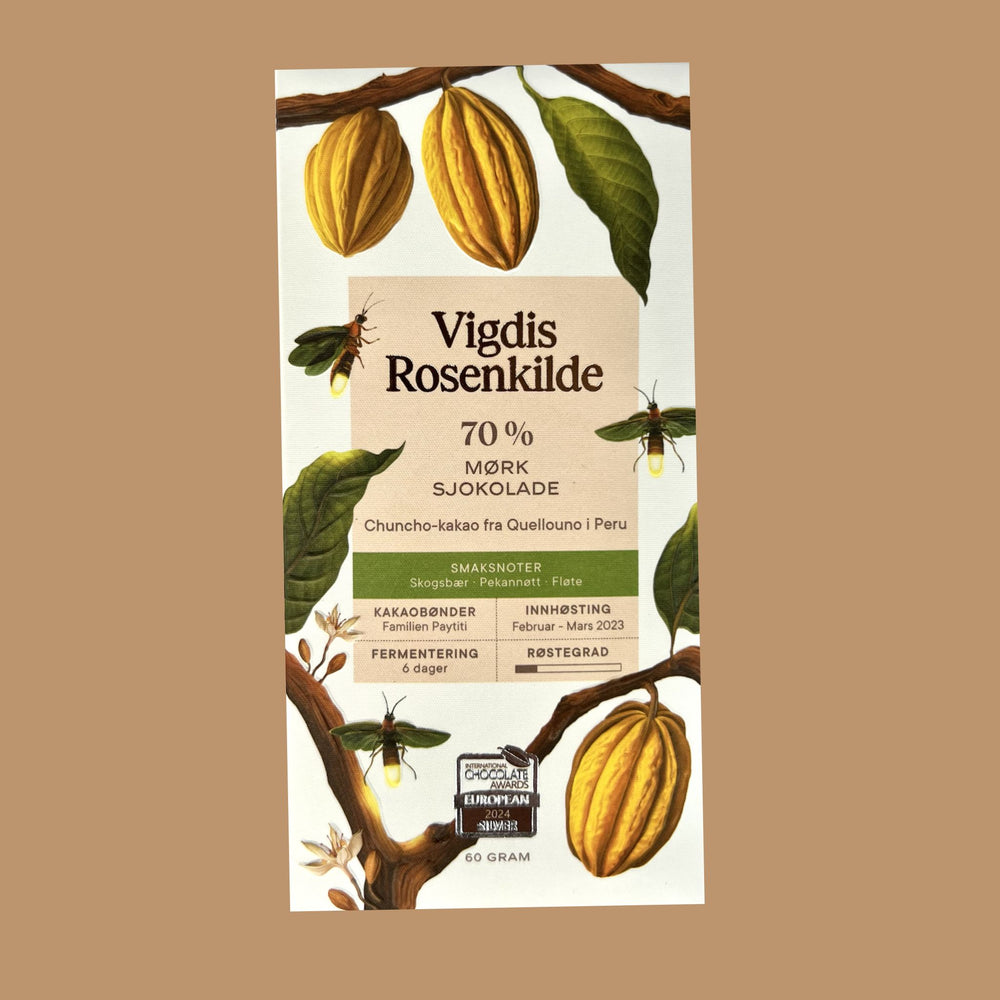
Vigdis Rosenkilde — 70% Koribeni Silver, 2026 European International Chocolate Awards (90.5) Origin: Koribeni Valley, Cusco, Peru Cacao variety: Chuncho Two ingredients: cacao and sugar
A collective edit from the people behind Hello Chocolate—bars we return to, argue over, and ultimately agree are worth your time.
Ihr Warenkorb ist leer
Geben SIe weitere €150,00 aus und erhalten Sie kostenlosen Versand!